Agent autonomy is turning into a setting. Ask to see the switch.
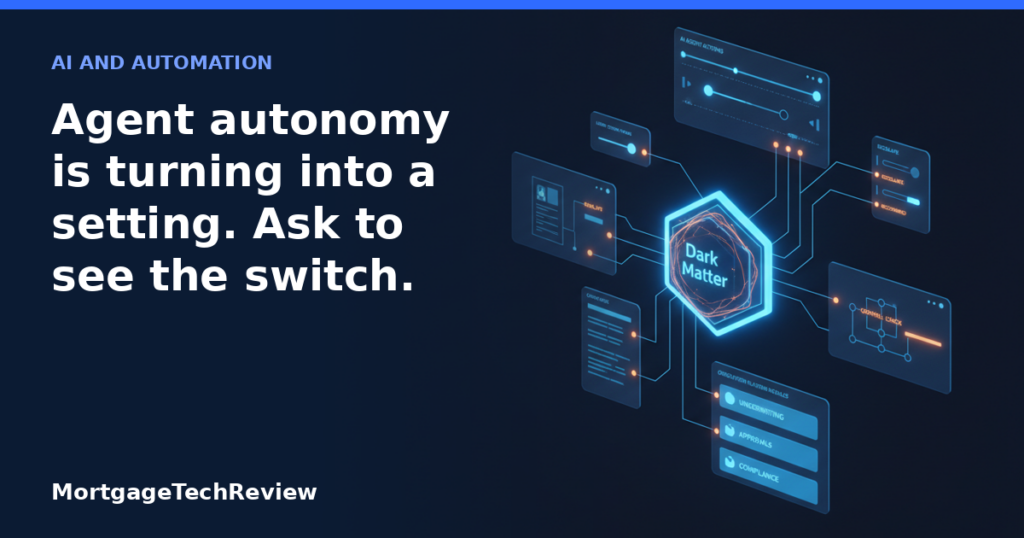
Reporting says Dark Matter will let lenders set when AI agents act, recommend or escalate. Here is how to check that control in an origination platform.
Dark Matter Technologies bought the AI agent platform behind House Numbers today. Terms weren’t disclosed. The detail that matters to a buyer sits in one sentence about control.
HousingWire reports the plan directly. Lenders will determine when agents can act independently, make recommendations, or flag items for human review. Lenders can also train agents on their own policies and procedures.
That is autonomy as a product setting. Most vendors still sell autonomy as a posture.
Read the tense before you read the feature
The reported sentence says lenders will determine. Dark Matter says customers should see new capability within weeks, with more releases over following months. The platform will run on Amazon Web Services.
Dark Matter’s own announcement describes different machinery. It names confidence gating, a code enforced compliance blocklist, and a complete audit trail. Per workflow model tiering and per loan cost attribution are in there too. The release also names a gateway built on the Model Context Protocol. Outside assistants work a loan file there under one human user’s permissions.
The release doesn’t describe a per agent choice between acting, recommending, and escalating. It says loan operations personnel supervise the agents. So the three mode control is reported by the trade press and not yet documented by the vendor. Treat it as unconfirmed until a configuration screen answers back.
Dark Matter’s scale figures are two years in production, more than 100 lenders, and 19 agentic use cases in production. Those are vendor statements.
Three different things get sold as human in the loop
A buyer hears one phrase and gets one of three mechanisms. They cost different amounts and they fail differently.
- One mechanism is permission scoping. The agent inherits a human role and can’t exceed it.
- Another mechanism is per action approval. A named action waits for a person before it runs.
- And lastly, there’s an autonomy mode per agent. The lender picks act, recommend, or escalate for each one.
Permission scoping answers who. Per action approval answers when. An autonomy mode answers how much. A vendor can ship the first mechanism alone and still describe the result as oversight.
What origination vendors publish today
ICE Mortgage Technology publishes the most specific account of the four checked here. Its compliance post says customers can enable or disable AI actions based on their risk appetite. It says lenders have granular control over the actions a chatbot may perform. The example given is a chatbot that talks to borrowers but can’t accept payments.
That post goes further on required human steps. It names human intervention in bankruptcy situations as a configurable example. It says human validation is required for critical decisions as specified by the user. A tier requiring approval across every step of a multi step task is described as planned.
nCino published permission and approval detail in August. Its Mortgage MCP connects outside agents to the nCino mortgage suite. Agents act within existing permissions. High impact actions can require human confirmation first, and archiving a loan officer is the published example. Actions are logged with the time, the action, and the outcome.
MeridianLink’s launch release for its agent line says humans stay in the loop. It doesn’t say what a lender sets. Its mortgage document agent was described as planned for general availability in Q4 2026.
Blend‘s Autopilot page describes document review, compliance checks, and follow ups. It names no lender set autonomy control. Absence from a product page isn’t proof of absence in the product. It is a reason to put the question in writing.
Seven questions that make the control real
- One question is scope. Ask which agents carry a mode setting, and which carry a single fixed mode.
- Another question is granularity. Ask whether the mode is set per agent, per action, or per loan type.
- A third question is the confidence rule. Ask what score routes work to a person, and who can edit that threshold.
- A fourth question is the escalation target. Ask which queue receives flagged items, and the response clock on that queue.
- A fifth question is change control. Ask who can switch an agent to autonomous, and whether the change is logged.
- A sixth question is the failure path. Ask what the agent does when a model provider fails mid condition.
- And lastly, ask for evidence. Ask for one audit record covering a single agent action, from trigger through approval.
Put these on a screen share, in your tenant, on one of your own files. A roadmap line isn’t a shipped field. Ask which release carries it, and whether it needs professional services hours.
This is a procurement question, not a feature question
An autonomy setting is a control your examiner will eventually ask about. The record has to show who set it, when, and on what authority.
So the setting belongs in your change management process from day one. Name the owner. Log every change. Then name the autonomous path in your post close sampling plan and sample it on its own.
What this does not change on the board
Announced capability isn’t observable capability. The House Numbers record moves to acquired, with no standalone offering. The Dark Matter origination and point of sale records gain announced AI capability that hasn’t shipped.
A mode setting becomes a product field when a release note or a configuration screen carries it. Nothing on the board moves on a press cycle.
The site tracks 317 products. Of those, 303 carry a published score. No vendor paid for a review. No mechanism exists to sell one.
What to measure once you turn one on
Autonomy earns its price only where it moves a number your shop already tracks.
So pick one condition type and run it both ways for sixty days. Compare cycle time from condition raised to condition cleared. Compare the rework rate on files where an agent acted and got it wrong. Compare contact rate on the borrower outreach an agent sends. Then put all of it against cost per funded loan.
A claim about oversight costs a vendor nothing to make. A setting you can point at in writing is the thing worth buying.
Compare before you take the demo. Every tracked product is scored on one public rubric. Browse the side-by-side comparisons or read the scoring method.
Questions buyers ask
What changed with the Dark Matter acquisition?
Dark Matter bought the House Numbers AI agent platform on 30 October 2026. Terms were not disclosed.
Can lenders really choose how much an agent decides?
Reporting says that control is coming. The vendor’s own release describes confidence gating and permissions instead, so treat the mode switch as unconfirmed.
Does this move any product score on this site?
No. Announced capability is not observable capability, so no score input moves until the integration ships.
Sources
- housingwire.comHousingWire, 30 October 2026, the acquisition, the wording on lenders determining when agents act independently, recommend, or flag for human review, 19 use cases, two…
- send2press.comDark Matter press release, 30 October 2026, confidence gating, code enforced compliance blocklist, audit trail, per workflow model tiering, per loan cost attribution,…
- mortgagetech.ice.comICE Mortgage Technology compliance post, 17 August 2026, enable or disable AI actions by risk appetite, granular control over chatbot actions, required human…
- ncino.comnCino Mortgage MCP release, 7 August 2026, agents act within existing permissions, high impact actions can require human confirmation, actions logged with time, action…
- meridianlink.comMeridianLink Intelligence launch, 12 May 2026, humans in the loop statement with no stated lender control, mortgage Doc Agent general availability planned for Q4 2026
- blend.comBlend Autopilot product page, read this run, document review and follow up described, no lender set autonomy control stated
- housingwire.comHousingWire, 25 February 2026, MCP gateway in the Empower origination system, identity validation, permissions, data limits and audit trail, no autonomy setting described
Products covered in this piece

Blend Labs